Disqualification for drink-driving
How long you must be without your driving licence depends largely on how high your alcohol level was and whether you have previously been convicted of drink-driving
For many people, losing their driving licence is undoubtedly what hurts most about a drink-driving conviction. It is a desperate situation that affects not only the convicted person but often the whole family. A heavy burden falls on the partner or spouse, who has to drive the family to school and leisure activities for a long time to come. Quite a few people depend on a driving licence for their job and risk losing that too.
Even so, the rules are applied quite rigidly, and it is difficult to avoid disqualification even if you lose your job. You will be told that the greater your need for a driving licence, the greater your reason to make sure you never drive under the influence.
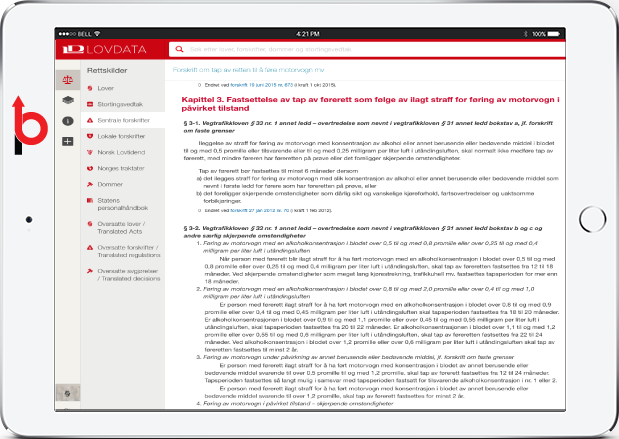
If you are convicted, it is difficult to avoid disqualification, but in some cases we can help you get the disqualification period reduced. You should not accept the disqualification period proposed by the police without first seeking some advice.The starting point for the disqualification period is how high your alcohol level was when you drove, and the courts have guidelines on disqualification periods. For example, these state that with an alcohol level over 0.5 and up to 0.8 per mille, the licence should be revoked for between 12 and 18 months.
Unless there are very special circumstances, it is therefore difficult to get the disqualification period below 12 months, but there is some room for manoeuvre between 12 and 18 months, and 6 months either way can make a big difference for many people.
Low alcohol level
Disqualification period for an alcohol level between 0.2 and 0.5 per mille
Main rule 0.2–0.5
An alcohol level between 0.2 and 0.5 per mille should not normally lead to disqualification from driving.
Exceptions
Even if the alcohol level is between 0.2 and 0.5 per mille, the driver may be disqualified if they hold a probationary licence or there are aggravating circumstances.
Disqualification period
If you hold a probationary licence and drive with an alcohol level between 0.2 and 0.5 per mille, the disqualification period must be at least 6 months.
Disqualification period
If there are aggravating factors (for example poor visibility, difficult driving conditions or dangerous overtaking), the disqualification period must be at least 6 months.
0.5–1.2 per mille
Disqualification period for an alcohol level between 0.5 and 1.2 per mille
Main rule for 0.5–1.2
The main rule is a disqualification period of 12 to 24 months (1–2 years).
0.5–0.8 per mille
If you are stopped at an ordinary routine check and there are no aggravating circumstances, the disqualification should be 12 to 18 months.
0.8–0.9 per mille
If you are stopped at an ordinary routine check and there are no aggravating circumstances, the disqualification should be 18 to 20 months.
0.9–1.1 per mille
If you are stopped at an ordinary routine check and there are no aggravating circumstances, the disqualification should be 20 to 22 months.
1.1–1.2 per mille
If you are stopped at an ordinary routine check and there are no aggravating circumstances, the disqualification should be 22 to 24 months.
EXCEPTION: REPEAT OFFENCES
The disqualification period of 12 to 24 months only applies to a first conviction for driving under the influence. If it is a second conviction and less than 5 years have passed since the previous one, the disqualification is "permanent" (that is, 5 years).
High alcohol level
Disqualification period for an alcohol level over 1.2 per mille
Main rule
If you have driven with an alcohol level over 1.2 per mille, the minimum disqualification period is 2 years.
Aggravating circumstances
If the alcohol level was very high (over 2.0 per mille) and/or there are aggravating circumstances, the disqualification period can be set at up to 5 years.
EXCEPTION: REPEAT OFFENCES
The 2-year disqualification period only applies to a first conviction for driving under the influence. If it is a second conviction and less than 5 years have passed since the previous one, the disqualification is "permanent" (that is, 5 years).
EXCEPTION: REPEAT OFFENCES
The 2-year disqualification period only applies to a first conviction for driving under the influence. If it is a second conviction and more than 5–10 years have passed since the previous one, the disqualification is 3 to 5 years.
Should I consent to my licence being seized?
If the police suspect you of drink-driving, they can seize your driving licence until the case against you is finally decided – typically when you are convicted or acquitted, or the case against you is dropped. If you do not consent to your licence being seized, the police must send the case to court within 3 weeks.
You will then be summoned before a judge who hears your version of events, and the court decides whether the conditions for keeping your licence temporarily are met. Whether you should consent depends on your chances of getting your licence back before the case is finally decided.
If the evidence against you is strong, the chance of getting it back is small. Conversely, it is possible to get it back if the evidence is weak.
Even if the evidence is strong, it may be possible to get it back if being without a driving licence until the case is decided would be disproportionately hard for you.
If you are suspected of drink-driving on an electric scooter, you should not simply consent to the seizure. You should seek advice from a lawyer, because more is required before the police can keep your driving licence.
Contact us to find out what your chances are of getting your driving licence back.
Lack of sobriety
Police throughout Norway appear to have adopted a practice of trying to revoke the driving licence of almost everyone caught using drugs. There is no legal basis for this, and if you are affected you should contact a lawyer before accepting such a revocation.
The law allows the driving licence to be revoked from people who lack a sober lifestyle, even if they have not been caught driving under the influence. This is a preventive measure, not a penalty.
It makes sense for the police to have this power, because it is sometimes necessary to take the worst drivers off the road for the safety of others. But it requires a lifestyle that is genuinely not sober. Drinking alcohol now and then does not meet that test. If it did, a large part of Norway's adult population would be without a driving licence.
A certain level of consumption, at a certain frequency over a certain period, must be shown before a licence can be revoked on these grounds. We see, however, that the police try to revoke licences as soon as a person admits to having used cannabis on a few occasions. That is not sufficient.
If you have received a letter from the police giving advance notice that your driving licence will be revoked, you should contact us so that we can assess whether there are grounds for the revocation. If it is not lawful, we help you write to the police in the hope of preventing it.